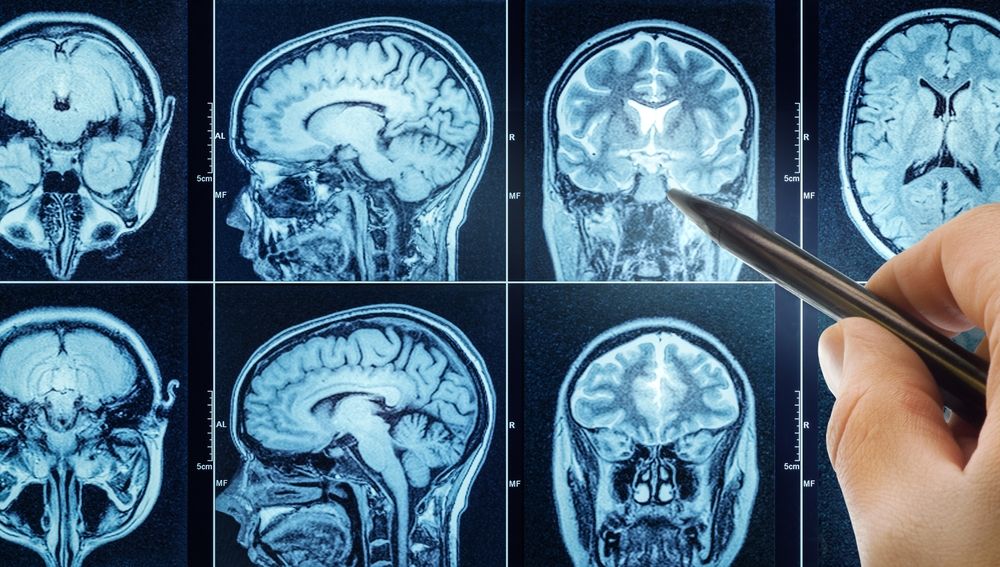
Researchers compared 13 patients with Parkinsion’s disease (PD) with minor hallucinations (PD-MH), 13 PD patients without hallucinations, and 13 healthy controls using multimodal EEG and MRI (resting-state functional MRI [fMRI] and diffusion tensor imaging [DTI]). Analyses focused on frequency-band power, large-scale network connectivity (default mode network [DMN], dorsal/ventral attention networks), and white-matter pathways. They also tested a deep-learning “visual reconstruction” approach that attempted to rebuild viewed scenes from EEG signals to probe whether hallucination-related neural activity carries usable visual information.
PD-MH showed increased alpha/theta and reduced gamma power on EEG, stronger DMN connectivity (notably the medial prefrontal-centric dorsal-medial subsystem), and a shift in network coupling—weaker DMN–dorsal attention network (DAN) links and relatively tighter DMN–ventral attention network links—consistent with attentional imbalance during ambiguous perception. DTI suggested sparser, more dispersed fiber tracts in DAN-related regions versus controls. In the reconstruction task, EEG from PD-MH failed to reliably distinguish whether a partner was facing the subject, whereas healthy-control EEG did, hinting that hallucination-prone brains carry less differential visual information. Together, findings point to coordinated EEG/fMRI markers of minor hallucinations in PD and support exploration of EEG-based reconstruction as an objective tool for hallucination assessment and early risk identification.
Reference: Liu C, Qu L, Li Q, et al. Global brain analysis of minor hallucinations in Parkinson’s disease using EEG and MRI data. Front Aging Neurosci. 2024;15:1189621. doi: 10.3389/fnagi.2023.1189621.